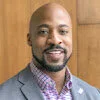
EP 20 Dr. Michael Prats, MD, and Dr. Shawn Sethi, DO
AI at the Ultrasound Bedside: Measurements, Teaching, and Trust
Guests: Michael Prats, MD, Ohio State University, and Shawn Sethi, DO, Duke University | Released 03/19/26
AI is already appearing on ultrasound machines, but a new button does not answer the question that matters at the bedside: when should a clinician trust what it produces? Dr. Michael Prats and Dr. Shawn Sethi join DJ and Ethan to examine that question through the work of point-of-care ultrasound. The Ultrasound GEL colleagues bring perspectives from clinical practice, research, and teaching, with a focus on where automated assistance is useful and where the operator's judgment remains essential.
Dr. Prats begins by separating measurement from interpretation. Calculating a value from a good image is a different task from deciding whether an image shows disease. Automated tracing and measurements may reduce repetitive work, but clinicians still need to recognize whether the system measured the right structure from an adequate view. The group distinguishes image recognition, acquisition guidance, quantitative measurements, and diagnostic interpretation rather than treating every ultrasound AI feature as the same capability.
That distinction becomes especially important in education. A learner may accept a displayed number without recognizing a poor-quality image or understanding the system's uncertainty. Prats and Sethi want clearer signals about image adequacy and model confidence. They also argue for teaching acquisition and interpretation alongside an explicit discussion of AI's limitations. Keeping the technology out of the curriculum is difficult when trainees will encounter it on the machine; introducing it thoughtfully means preserving the skills needed to question its output.
The conversation brings those ideas back to a busy emergency department. AI might help clinicians extract more information from a scan, but the value depends on how it fits into the work. The guests discuss measurements they use, features emerging in image review and documentation, and capabilities they hope to see develop. When an output conflicts with a clinician's interpretation, Prats describes trying to understand the disagreement. Identifying an acquisition problem or a recurring algorithmic weakness can make the next use more informed.
Access and equity add another layer. Ultrasound varies with the operator, equipment, settings, and patient population, raising questions about whether a model will work outside its training environment. In settings with fewer teachers or imaging resources, AI assistance could be useful, but education, local champions, connectivity, hardware limitations, and maintenance still matter. The guests call for stronger evaluation and clinician involvement in development, while recognizing that access to an algorithm's inner workings may remain limited.
Looking ahead, Drs. Prats and Sethi anticipate changes in measurements, image review, and workflow before a wholesale replacement of bedside teaching. They discuss patient-performed ultrasound as an emerging area of experimentation, with practical and educational questions still to resolve. The hosts' opening segment takes a wider look at AI agents through OpenClaw, considering both their ability to carry out tasks and the risks of connecting them to personal systems. Across both discussions, the recurring theme is learning enough about a tool to judge how, and whether, it belongs in your work.
What we cover
• 🩺 Separating ultrasound measurement from diagnostic interpretation
• 📐 Automated measurements and the importance of image quality
• 🎓 Teaching learners to question AI-generated numbers
• 🔎 Investigating disagreement between the clinician and the algorithm
• 🌍 Education, infrastructure, and access in resource-limited settings
• 🤝 Clinician input, external validation, and vendor transparency
• 🛠️ Where AI agents and ultrasound automation meet real workflows
Resources discussed
• Ultrasound GEL, the guests' podcast reviewing point-of-care ultrasound literature.
• OpenClaw, discussed in the hosts' opening segment. The conversation reflects the state of the project at recording.
Connect with the guests
Michael Prats at Ohio State · Shawn Sethi at Duke